Termii Has Evolved
A customer opens their banking app to move money before a deadline. The app asks for a one-time code.
Five seconds go by. Fifteen. Thirty. Nothing shows up.
They refresh the app. They check the spam folder, just in case a six-digit number decided to hide there. They try again. Somewhere in a queue, the message has technically gone out, but "sent" and "arrived" aren't the same thing, and from where the customer is sitting, there's no meaningful difference between the two.
Eventually the code shows up. Or it doesn't. Either way, something has already happened that no delivery report will ever capture: the customer has just found out, in real time, whether this business can be trusted with something urgent.
What happens next?
That's the question most communication infrastructure was never really built to answer: not "did the message go out," but what happens once it does, or doesn't. It's also, in a fairly direct way, why Termii has evolved.
The message was only ever the starting point
For years, the sensible move for any business moving money or verifying identity at scale was to treat delivery as the whole job. Get the OTP out. Get the fraud alert out. Get the payment confirmation out - reliably, in a market where network quality and vendor coverage can shift week to week. Do that well, and you've cleared the hard part.
That instinct wasn't wrong. It still isn't. Delivery is not a solved problem across most emerging markets; it's an ongoing operational discipline, and a single-vendor setup with no failover means one degraded provider takes every message behind it down with it. This is the layer Termii calls Signals: sender identity, routing and automatic failover across SMS, WhatsApp, voice and email, with delivery confidence and fraud risk scored in under 50 milliseconds - before a message even leaves the building.
Signals is still doing that job, at real scale. Termii has processed more than 3 billion transactions across 190-plus countries. It's the foundation on which everything else at Termii is built. But a foundation was never meant to be the whole building.
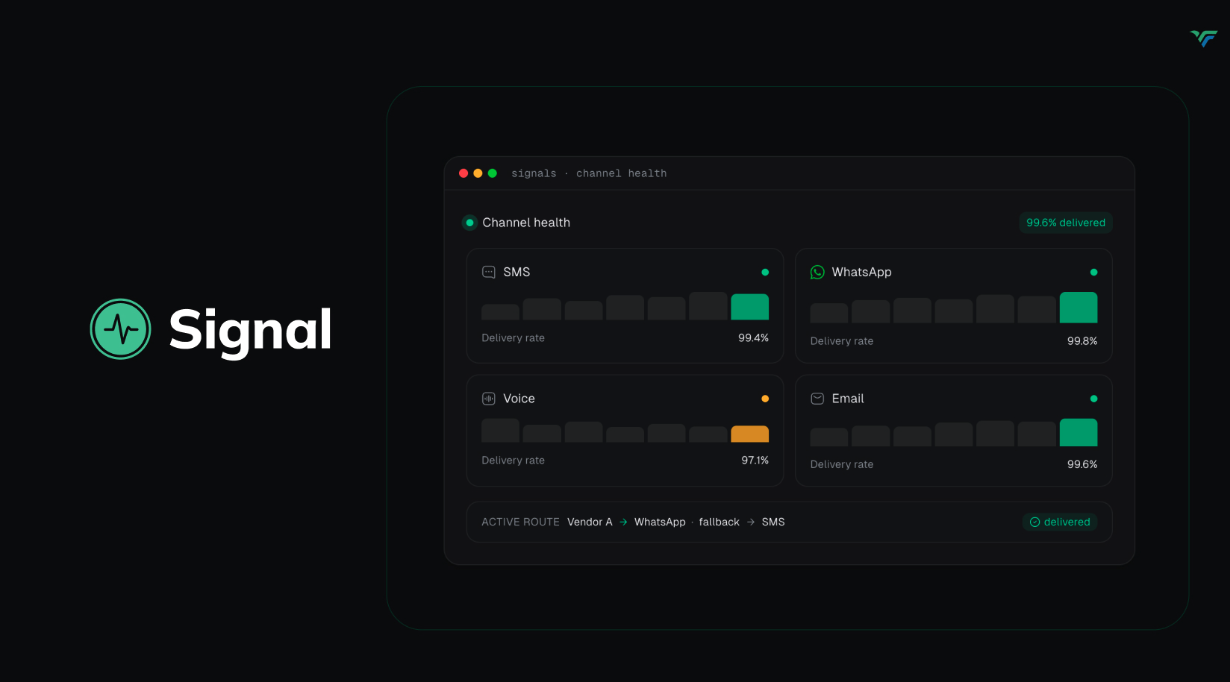
Signals: channel health dashboard showing delivery rates across SMS, WhatsApp, voice and email, with an active route and fallback
Delivery isn't the whole interaction
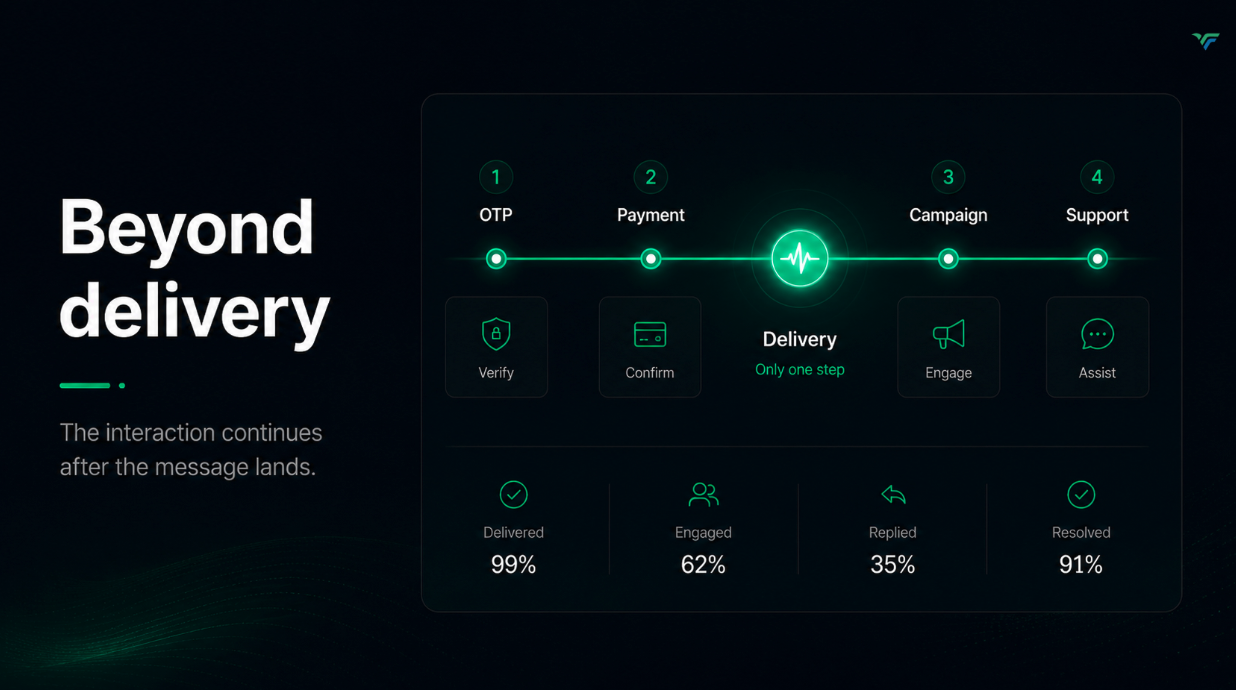
It's easy to lose sight of this when "did it go through" is the number everyone's watching. Delivery isn't the end of an interaction; it's closer to the middle of one.
Beyond delivery, the interaction continues after the message reaches the customer: OTP, payment, delivery, campaign and support
A customer gets their OTP. Maybe they finish logging in. Maybe the code shows up two seconds after the session times out, and now they're calling support instead.
A payment goes through. The customer expects a confirmation, might have a question about a fee, and might come back next week wondering why a debit doesn't match what they thought they'd approved.
A promotional message goes out. It gets ignored because it showed up on the wrong channel at the wrong hour, or it works because it was actually relevant, and now there's a decision to make about what to do with that.
A customer writes in for help. This is usually the moment that decides whether everything before it gets remembered as reliable, or filed away as friction.
None of this is an edge case. It's the interaction. A business that only optimises for delivery has really only optimised for the opening seconds of a relationship that keeps going long after.
The customer doesn't experience your org chart
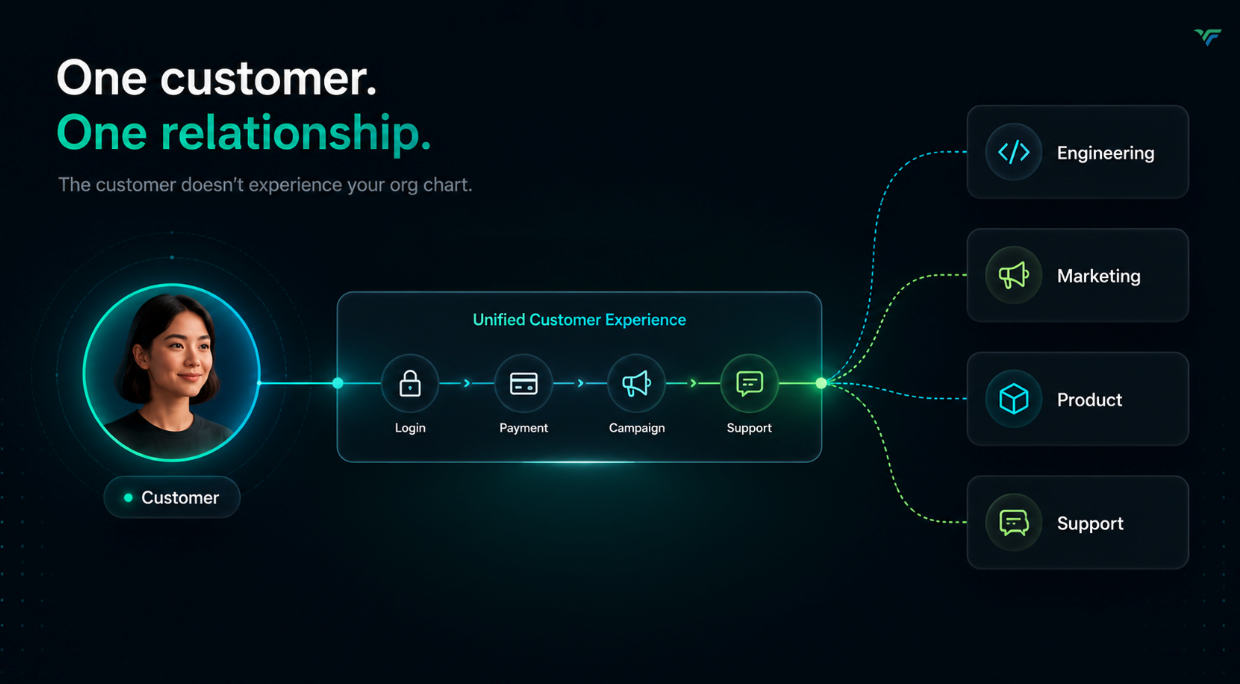
This is usually where things come apart internally. Engineering owns the messaging pipeline. Marketing owns the campaign calendar. Product owns the journey maps. Support owns the inbox, or several inboxes, since a customer who doesn't hear back on WhatsApp will just try Instagram next, then email, then a phone call, until someone finally answers.
One customer, one relationship: a single unified customer experience across login, payment, campaign and support, behind engineering, marketing, product and support teams
Every one of those teams can be doing its job well. But the customer isn't dealing with four teams; they're dealing with one relationship, and to them it's continuous. A login, a payment, a promotion, a complaint: all the same trust, extended to the same business, over and over. When the systems behind that relationship don't talk to each other, the customer usually notices first. They repeat themselves. They get a cheerful upsell right after a failed transaction. They wait in a queue that has no idea what already went wrong.
Closing that gap, without asking businesses to rip out what already works, is what the new Termii is actually for.
The new Termii
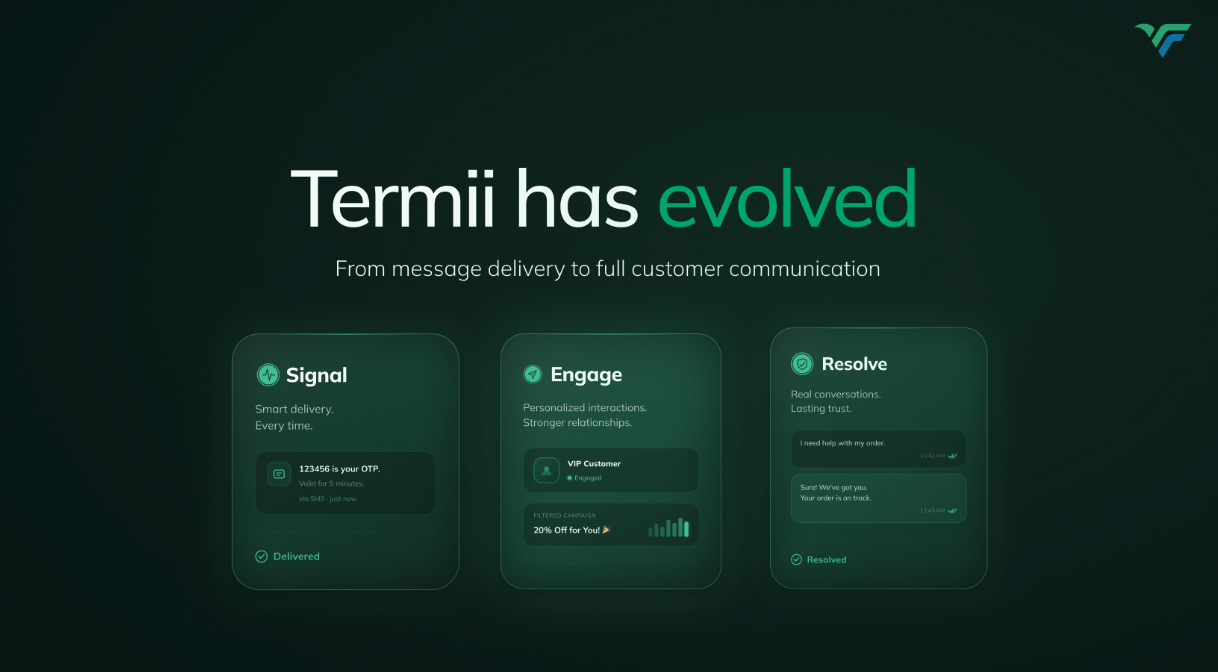
The platform is now built around three layers of the same relationship, with one layer of intelligence running underneath all of them.
See the new Termii in action
Before we go deeper into each layer, watch this short walkthrough of Termii V4 to see how Signals, Engage, Resolve, and Ayla work together in one platform.
[Watch: What’s New on Termii V4]
3-minute product walkthrough
(video link to embed https://youtu.be/UZnZ08rTfxo)
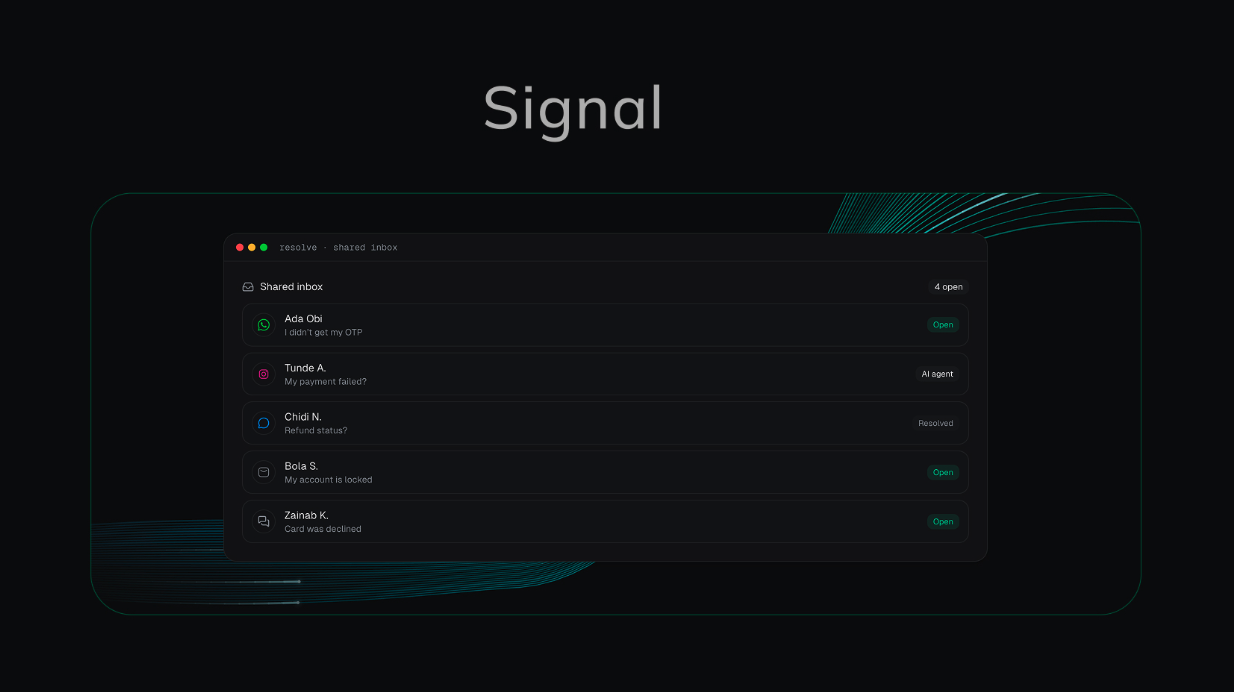
Signals delivers the transactions that have to go through: OTPs, fraud alerts, payment confirmations, compliance notices, with routing and failover across SMS, WhatsApp, voice and email.
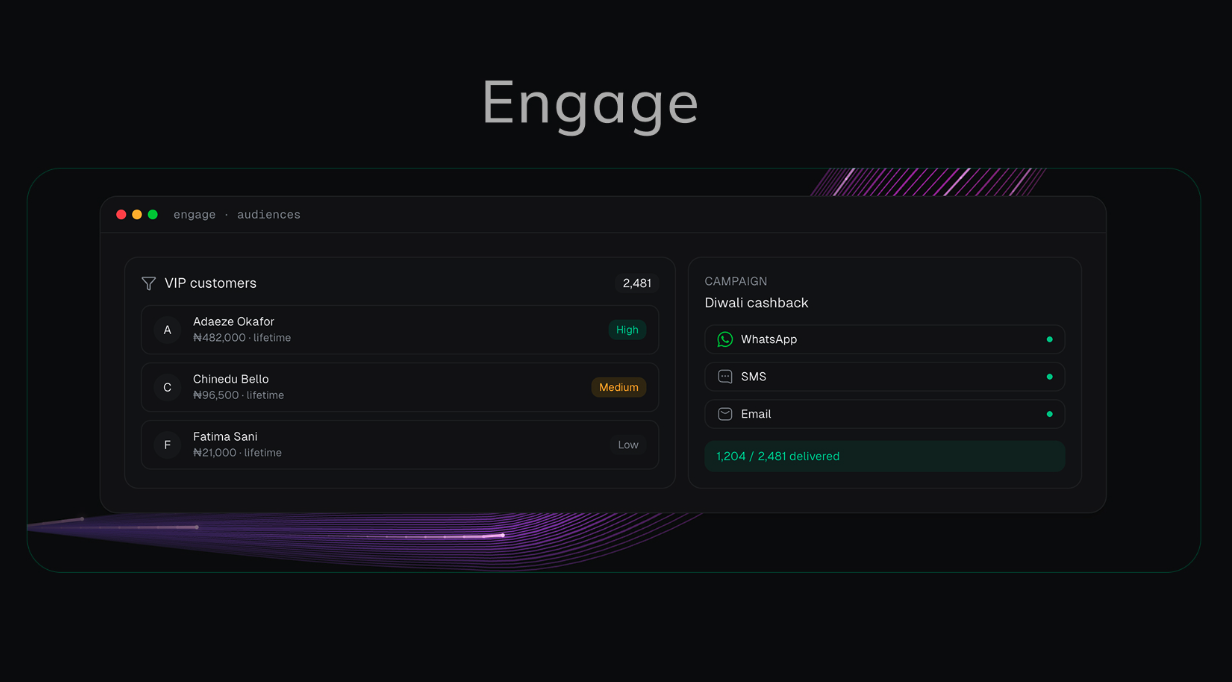
Engage takes over from there. Rather than treating every customer as one list to blast, it unifies customer data into profiles and segments: a high-value user, a dormant one, someone who just finished onboarding - and runs campaigns and multi-step journeys across SMS, WhatsApp, Email and Push Notifications, timed to when each group actually reads their messages. It's not about sending more. It's about sending the right thing, to the right person, on the channel they'll actually open.
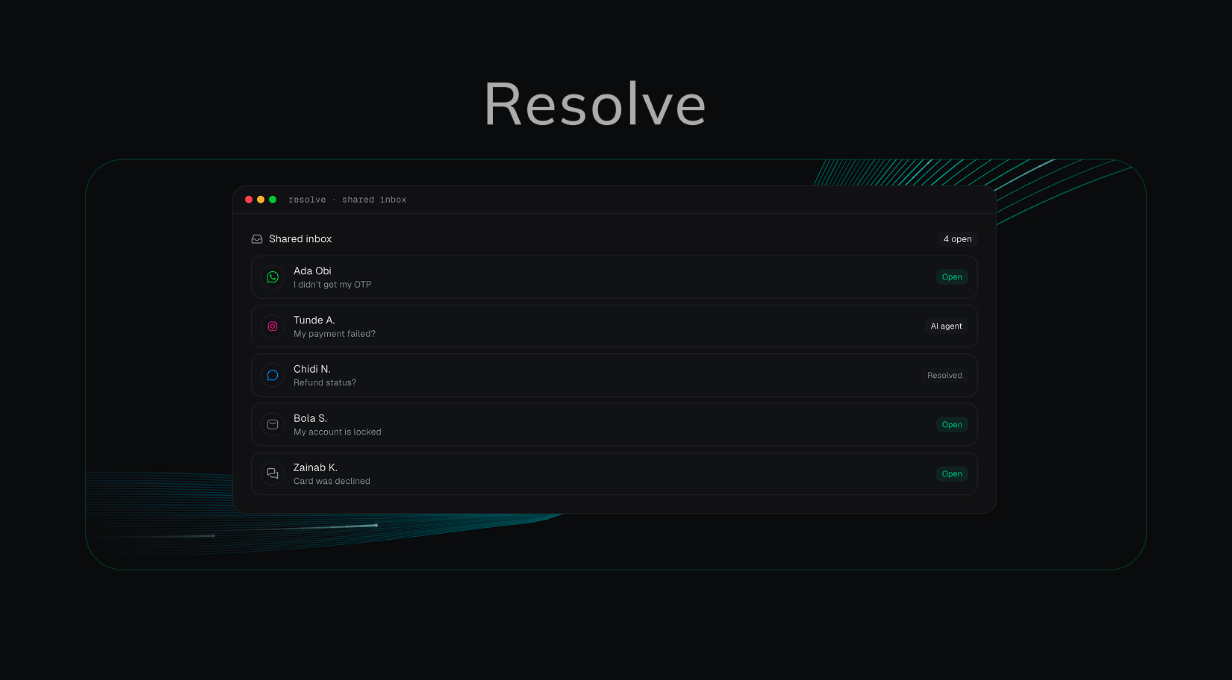
Resolve picks up when a customer needs something back. Instead of five separate queues across WhatsApp, Instagram, Messenger, live chat and email, it's one shared inbox with the customer's full history already attached, so whoever picks up the conversation - a human agent or an AI agent handling something routine - isn't starting from nothing. By Termii's own numbers, most of these requests get closed without a human touching them at all.
Underneath all three sits Ayla, Termii's AI layer, trained on billions of real transaction signals. Ayla scores delivery confidence and fraud risk before a Signal goes out, decides which segment a customer belongs in for Engage, and resolves the routine cases in Resolve. It's the same intelligence, applied at each stage of the same relationship, rather than three separate tools that happen to share a logo.
None of this means every business needs all three layers from day one. A fintech that's only ever needed airtight OTP delivery can keep running exactly that, on Signals alone, and nothing changes for them. What changes is the ceiling above it. The infrastructure a business already trusts with its hardest problem - making sure a transaction doesn't quietly fail - is the same infrastructure it can grow into for engagement and support, instead of stitching together a CRM, a campaign tool and a helpdesk that have never once shared a customer record.
What this changes for businesses
Once delivery, engagement and resolution live on one platform, a handful of decisions get simpler.
Reliable messaging and good customer experience stop competing for the same budget line; they were always the same customer, at different points in the same relationship. There's one view of what actually happened to a person across a transaction, a campaign and a support ticket, instead of three exports someone has to reconcile by hand on a Friday afternoon. And the reliability question grows up a little: not just "did the OTP go out," but "did the customer end up somewhere good because of it."
That's a different way to think about a communication platform, less about how fast you can send something, more about how much of the customer's actual journey you can see, and do something about.
What happens next
Back to that customer, still waiting on a code.
The old question was simple: did the message go through? It's still the right first question, and it's one Termii has spent years getting right at scale. But it was never the last one. What happens after the code arrives, or doesn't — the decision it triggers, the conversation it opens, the trust it earns or spends — is the part of the relationship that used to sit entirely outside the platform.
The new Termii is built for that whole stretch, not just its opening line.
Explore the new Termii, including a short walkthrough of the V4 platform, at termii.com.
Your customers trust you at the moment that matters most. Every OTP, payment signal, fraud check and alert is a promise. Termii makes sure you keep it.